
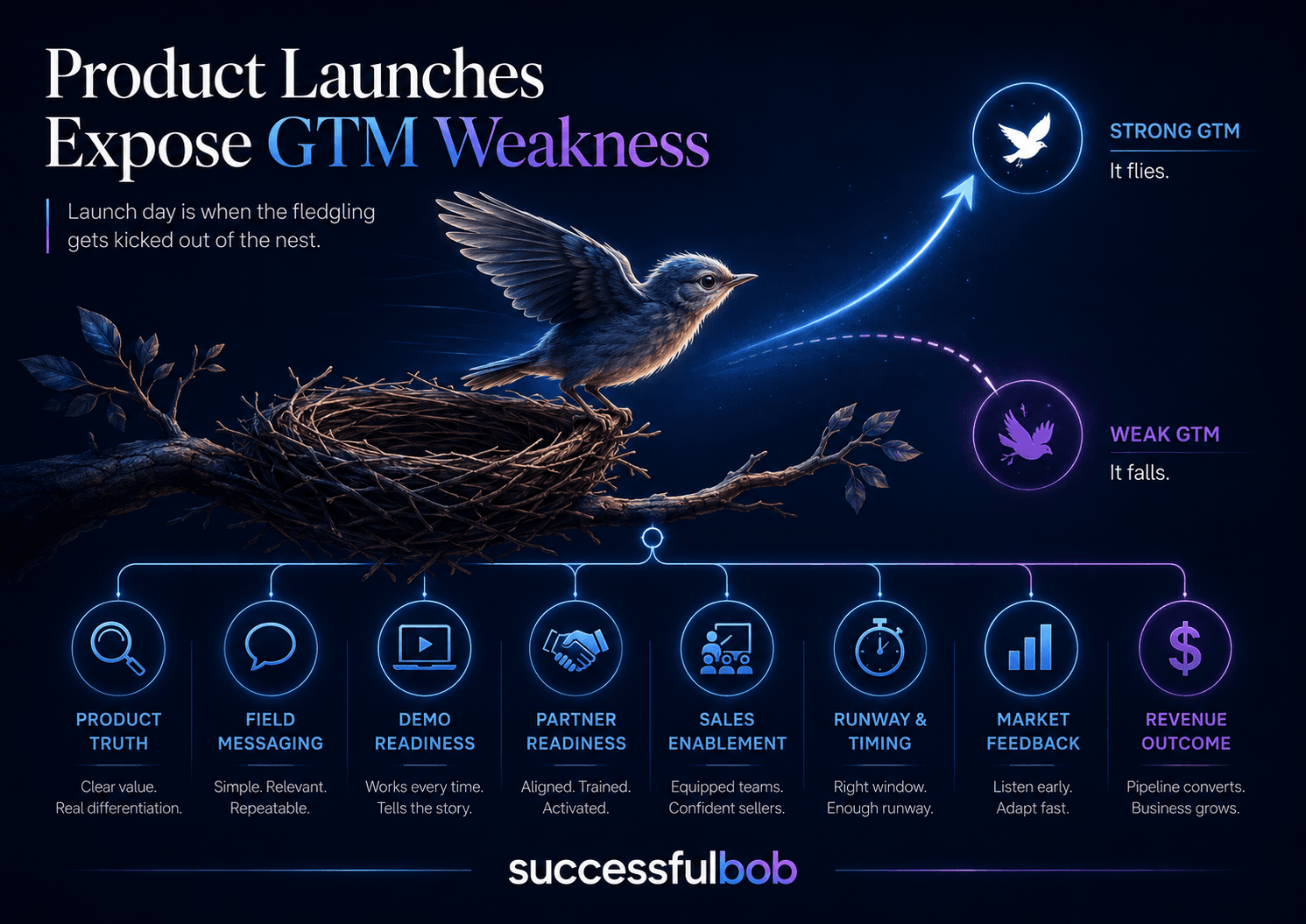
Product launches expose GTM weaknesses because they force a company to translate what it built into something the field, partners, prospects, and customers can understand and act on. The product team may know exactly why something was built, but launch readiness requires everyone else to understand what it does, why it matters, who cares, and how to communicate that consistently. A launch usually doesn’t create GTM problems. It exposes the ones that were already there.
The first requirement is painfully obvious: the product has to work. If it doesn’t, you don’t really have a GTM problem yet. You have a product problem. Problem solved.
Assuming we clear that incredibly low bar, the harder question is whether the rest of the company is actually ready to take that product into the market.
The people who built the product usually know why it exists. Maybe a customer had a specific pain. Maybe a competitor was doing something you couldn’t. Maybe the board wanted it. Maybe Product saw an opportunity or Engineering found a smarter way to solve something. Whatever the reason, that context tends to live inside the heads of the people closest to the product.
Unfortunately, the field doesn’t particularly care why everyone spent the last nine months arguing about it. They need the useful version:
What does it do? Why does it do? Who has the product do? Who makes it do? Why would they want it to do? Why do they care that it does it now?
Yes, some of those questions are intentionally grammatically questionable. But if your team can’t answer them clearly, the grammar is probably the least of your launch problems.
That translation work is what turns something you built into something somebody can actually take to market.
A Launch Can Run Out of Runway
One of the most common problems I’ve seen is simply that Product or Development misses the original target dates. Maybe it’s only a week at first, then two. Launch assets have to wait because the product is still changing. Product Marketing is waiting for screenshots, feature details, messaging decisions, pricing, documentation, or final confirmation on what is actually shipping.
Eventually everyone runs out of runway.
What was supposed to be a real launch becomes something much softer. The product is technically available, there’s a press release, maybe somebody updated the website, but it doesn’t have the oomph of a real launch because the organization never had enough time to prepare the market-facing motion around it.
You didn’t necessarily launch badly. You just never really got to launch.
Leadership Can Create the Same Problem
The other version is almost the opposite. The product may be ready, but leadership keeps changing its mind right up until the end.
A messaging change comes in here. Positioning shifts there. Someone wants a different target market. Another competitive angle gets introduced. A feature gets pulled into the story at the last minute. Someone wants the campaign changed, someone else wants the sales deck updated, and suddenly the battle card, demo, partner materials, event messaging, website, and everything else downstream needs to change too.
Somewhere in the middle of this, Product Marketing is expected to magically synchronize the entire GTM system in real time.
That’s how you end up with a disjointed launch. It isn’t necessarily because the people executing it are bad at their jobs. You simply cannot continuously change the source of truth and expect every downstream representation of that truth to remain coherent.
At some point, decisions have to become decisions.
GTM-Ready Means Everyone Has the Same Truth
Once the product works, you need a documented set of truth around it. What does this product do? Why does it do it? Who has the product do? When should they make it do the thing? What problem does that solve, who owns that problem, and why should that person care?
Once you have those answers, they need to travel.
They need to become PR and broader market communication. Sales needs them through the normal enablement process. The channel needs a version that allows partners to understand, position, and repeat the story. Events and campaigns need standardized field messaging. Existing customers and prospects probably need to hear about it. Where it makes sense, relevant analyst communities can help magnify it.
The goal isn’t to hand everyone the same deck and declare victory. Different audiences need different translations.
But they should all trace back to the same truth.
If Marketing thinks the product solves one problem, Sales thinks it solves another, the SE team demos something else, and the partner community has invented a fourth version, you don’t have four clever market motions.
You have a launch problem.
Your First Demo Is Still a Prototype
A true product launch has another unavoidable weakness: you don’t have enough field feedback yet.
You simply haven’t demoed the product enough to customers and partners to know what’s relevant, what gets people excited, what generates questions, and what lands with an audible thud.
So the first launch demo is really a prototype of what you think people should care about.
You think one feature will be the star. You think a particular workflow will resonate. You think this specific pain is what buyers will latch onto.
Then you start showing it to people and reality gets a vote.
The thing everyone internally loved barely gets mentioned. Some little workflow you almost skipped produces five questions. Customers repeatedly bring up a use case you hadn't prioritized. Partners start describing the value differently than you do.
That isn’t necessarily evidence that the demo failed. That’s the feedback you needed in order to make the demo good.
The mistake is treating the launch version as finished instead of treating it as the first hypothesis you finally have enough audience to test.
Partners Are Really Good at Finding the Holes
Partner communities are especially useful here because they bring two things your internal teams can't easily manufacture.
First, they don't have your curse of knowledge. Second, they have their own experiences, priorities, customers, and ways of looking at the problem.
Someone who has lived inside your company for two years can hear an incomplete explanation and mentally patch the hole without even realizing they did it. They know what you meant because they know everything surrounding it.
Your partner doesn't.
They ask, “Wait, why would the customer care about that?” Or, “Who actually owns this problem?” Or, “Is that included in the product?” Or simply, “Why would I lead with this?”
When you’re racing toward launch, those questions can feel like friction.
They're really free QA for your GTM.
They're finding the places where your story only works if someone already knows the story.
If I Only Had Two Weeks
If I had two weeks before a launch and wanted to capture as much useful information as possible, I’d probably attack it from three directions.
First, I’d train the channel. Give partners the product and the story, then let them ask pointed questions. Their confusion will expose assumptions, missing context, weak messaging, and places where the value still relies too heavily on insider knowledge.
Second, I’d put SDRs into the market and have them start trying to generate interest. I wouldn’t just count meetings. I’d pay very close attention to the no’s. Why didn’t they care? Wrong person? Wrong pain? No urgency? Bad explanation? Then I’d look at the yes’s and start clustering around whatever those people have in common.
Third, I’d put the product in front of loyal customers or Customer Advisory Board members. They know enough about your existing offering to understand where the new product fits, but they aren’t trapped inside your internal assumptions. They'll generally give you fairly graceful criticism too, which is a nice bonus before the rest of the market gets its turn.
Between those three groups, you should learn an enormous amount very quickly. More importantly, you'll start replacing internal assumptions with actual market evidence.
Launch Day Isn't Graduation Day
This is probably the biggest philosophical problem I have with the way companies talk about launches.
A press release goes out. Someone changes the website. The product can technically be purchased. Maybe there’s a launch event and everybody gets cupcakes.
Then someone marks the project complete.
But a real leader shouldn't consider a product launch successful because the product became legally procurable on Tuesday.
The product was launched for a reason. Presumably there was an expected business outcome attached to all of this work. Revenue needs to get booked. Customers need to use the thing. It needs to operate in multiple real environments. The field needs to prove it can sell and explain it without the people who built it hovering over every conversation.
Until then, you have a fledgling.
You've fed it, fussed over it, taught it everything you think it needs to know, and eventually launch day arrives.
That's just the day it gets kicked out of the nest.
What happens next is when you find out whether it can actually fly.