
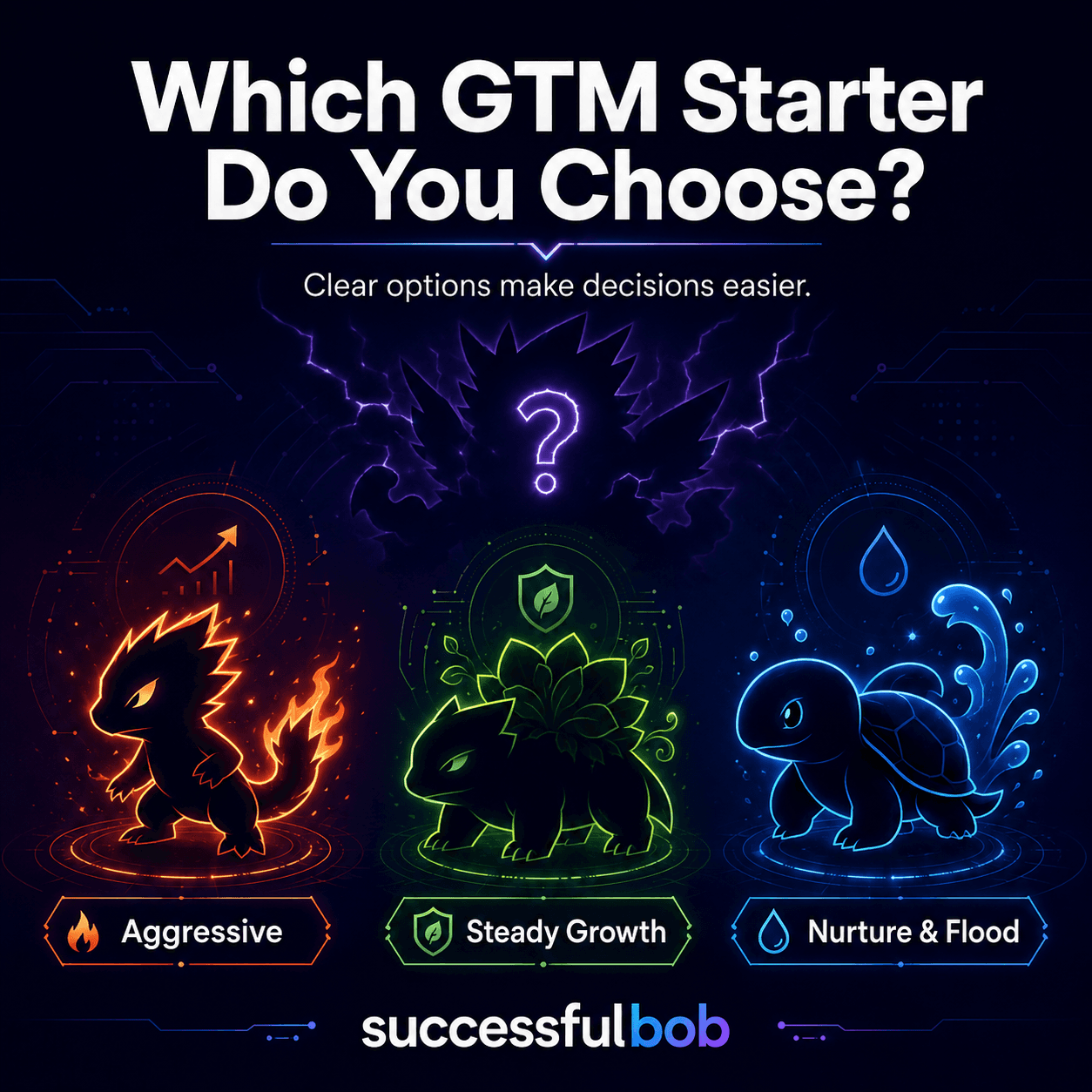
Clear options help buyers make decisions because reacting to a defined set of choices is easier than creating an answer from scratch. Even when none of the options is exactly right, a few distinct paths give people something to compare, reject, modify, or build from. The important part is that the conversation moves.
People make hundreds, maybe thousands, of decisions every day. What to wear, what to eat, which route to take, which notification matters, which ad to ignore, what to watch next.
We are incredibly well trained to react to choices.
What we are much less practiced at is creating something from nothing.
We don’t even need to invent our own entertainment anymore. There is always another reel, video, game, show, or post waiting for us. So when you suddenly ask someone in a business conversation, “What do you want?”, you may think you are giving them freedom.
You may actually be giving them homework.
If you are lucky, they say, “I’m not sure.”
If you are unlucky, the conversation just dies.
Give people something to react to
A few finite options change the task completely.
Instead of asking someone to invent the answer, you are asking them to classify and judge a few possibilities.
“That one feels closest.”
“I definitely don’t want that.”
“I like A, but I’d want part of B.”
“None of these work because you are missing something important.”
All of those answers are useful.
Once someone has a grounded starting point, it becomes much easier to think creatively from there.
Which brings us, obviously, to Pokémon.
Pick your GTM starter
If you had to choose a go-to-market Pokémon starter, who are you taking?
Charmander is passionate, fiery, and aggressive. Run every campaign. Make every call. Have every conversation. Sign every partner. Light it all on fire and create motion.
Bulbasaur is slower, more defensive, and built around deep roots. Create the case studies. Build organically. Stand behind every claim. Earn referrals. Grow something that is difficult to knock over.
Squirtle is the nurture-everything strategy. Water every relationship. Pour into every opportunity. Keep filling the pipeline and trust that enough consistent activity will eventually create downstream results.
And then there is Pikachu.
What plan? What rules?
Throw your all-star out there and let them shock everyone.
Maybe you have one founder, rep, SE, executive, or technical person who can seemingly make anything happen. It is not exactly a scalable system, but somehow Pikachu keeps winning.
The point is not that one of these is objectively right.
The useful part is what happens when you react to them.
Maybe you immediately think, “I’m absolutely Bulbasaur.”
Great. You classified yourself.
Maybe you think Squirtle sounds terrible.
Also useful. Why?
Maybe you want Bulbasaur’s defensibility with Charmander’s aggression and a little Pikachu chaos.
Now we have something to talk about.
Even “none of these” is progress
If someone rejects every option, that is still a decision.
More importantly, there is probably a reason behind it.
Maybe they do not have enough information to choose.
Maybe you missed the actual pain.
Maybe none of your options includes the thing they care about most.
Maybe they are not actually in a position to make the decision.
That is all useful information if they feel safe enough to explain it.
The outcome that tells you almost nothing is indefinite indecision.
I do this in my own business
If you go to my website, you will see multiple ways to work with me.
Some people want advisory. Others want project work. Within those paths, there are still a few different choices.
That is intentional.
The goal is not to make the page look bigger. It is to give people something they can self-identify against.
“This sounds like me.”
“That is more than I need.”
“I like this structure, but I would want it more often.”
Now we have a conversation.
That is much easier than asking someone to invent a completely custom consulting engagement from a blank page.
Avoid Cheesecake Factory syndrome
There is, of course, a point where choice stops helping.
Give someone too many options and you create the same problem all over again.
I think of this as Cheesecake Factory syndrome.
You open the menu and there are roughly eight thousand things you could order. Everything is slightly different, and suddenly you are trying to determine whether you have selected the exact right combination of protein, sauce, sides, toppings, and cheesecake-adjacent variables.
At some point, the fear of choosing wrong outweighs the fear of not choosing at all.
That is not useful optionality. That is decision paralysis with appetizers.
The choices need to be limited in number and obviously different enough that someone can quickly build a mental classification system around them.
Your choices also need to be real
There is an ethical line here too.
If you give someone an option, they may actually pick it.
So every option should be something you can genuinely execute as advertised.
If I offer monthly advisory or weekly advisory at different prices, someone should be able to choose either one and receive the value I described.
If only one path is legitimate and the others exist purely to manipulate someone toward it, that is not a list of options.
That is coercion.
Don’t be that guy.
You don’t get a Pokémon.
Progress the decision
When you are trying to move a deal, opportunity, meeting, or internal conversation forward, open-ended creativity is not always your friend.
Give people a few real, distinct choices and let them react.
Maybe they choose Charmander.
Maybe Bulbasaur.
Maybe Squirtle.
Maybe they reject the whole premise and demand Pikachu.
That is fine.
The goal was never to force them into one of your boxes.
The goal was to make it easier for them to decide what they actually want.
And if the answer is that every option is wrong, you still learned something.
Fail forward.