
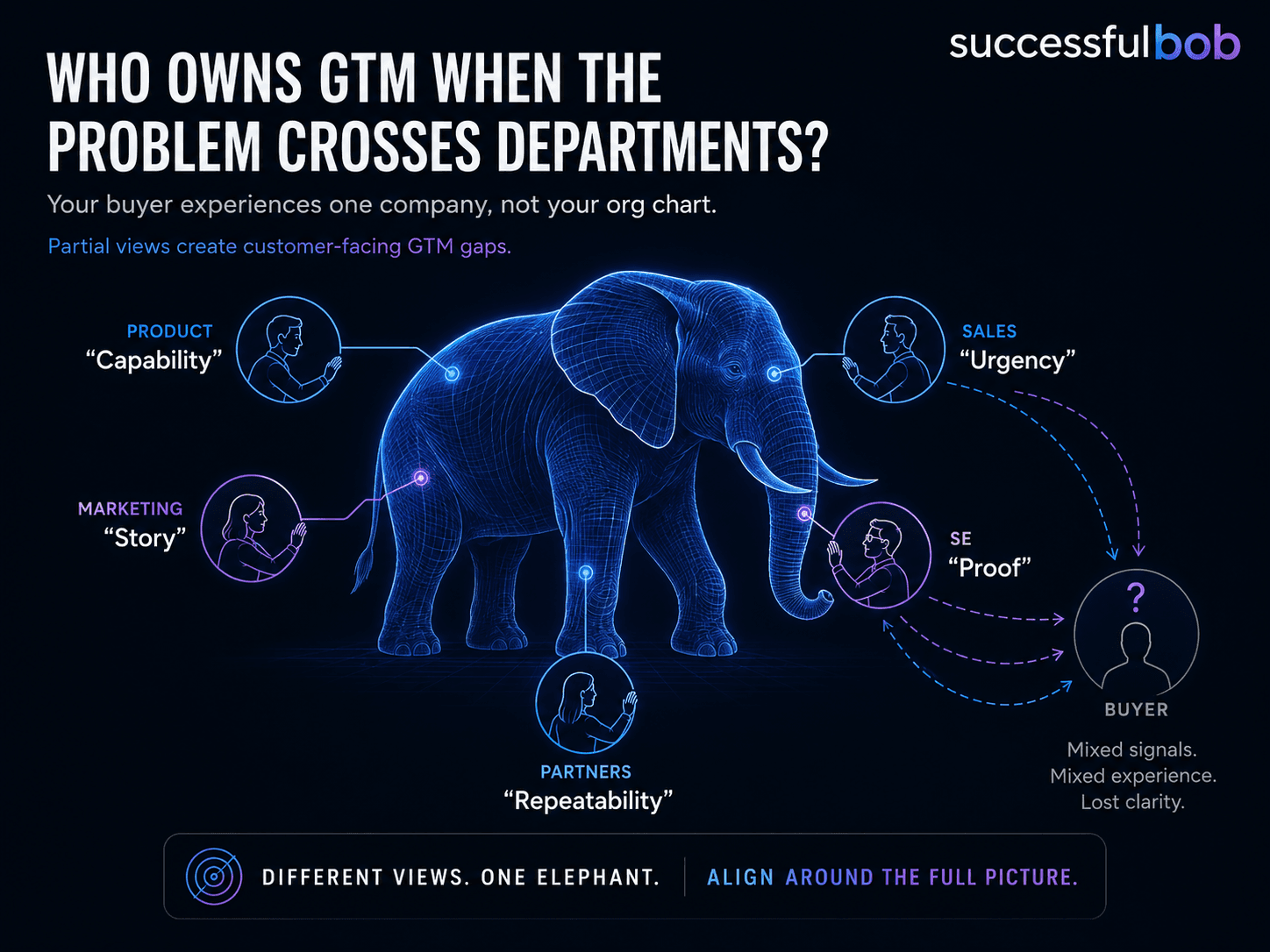
When a GTM problem crosses departments, the symptom usually gets blamed on whichever team it appears closest to. Product missed the message. Marketing picked the wrong campaign. Sales can’t close. Partners aren’t activated. But when the same problem touches multiple functions, that’s usually referral pain, not root cause. Ultimately, leadership owns it because with no GTM, there isn’t much left to lead.
That doesn’t mean every problem is systemic. Sometimes a seller really can’t close. Sometimes the messaging really is weak. Sometimes Marketing really did choose the wrong audience.
The trick is figuring out whether you have a bad branch or a problem with the tree.
Everyone Can Do Their Job Well and Still Lose
Here’s a common version of this.
Sales comes back and says three important deals need a particular feature to close. Leadership looks at the opportunities and decides the feature is worth prioritizing.
Totally reasonable.
Product pivots to build it. Product Marketing starts communicating the new capability. Sales gets the thing they asked for and hopefully closes those deals.
Meanwhile, Marketing has already built campaigns around the published roadmap. Those campaigns may be excellent. They may be exactly what Marketing was told to create.
There’s just one small problem.
That roadmap isn’t really the roadmap anymore.
Now Marketing is promoting the plan that existed before the pivot. Product is building something different. Sales still remembers all the best parts of everything it has ever been told because, well, those things are much easier to sell. Product Marketing is trying to explain the new reality, but the broader market motion is still anchored to the old one.
Every department can be performing its own assignment competently while the company as a whole tells four different stories.
That’s the danger.
The problem isn’t necessarily that somebody failed to do their job.
It’s that everyone did their job separately.
Product Changes Faster Than the Story Around It
From what I’ve seen, Product is often where the chain starts to drift.
Product takes new priorities, customer requests, competitive pressure, roadmap changes, engineering realities, and leadership direction. That’s part of the job.
What doesn’t always happen well is communicating the downstream implications of those changes.
Marketing is often very good at executing what it was told to execute. The problem is that Marketing may not realize the technology underneath the campaign has moved.
Sales feels the downstream effects differently. If Product changes and Marketing hasn’t caught up, sellers are left trying to reconcile what they were trained on, what the customer is asking for, and what the product can actually deliver today.
That’s where inconsistency starts turning into credibility risk.
But somebody has to keep recalibrating the story to reality, and that responsibility can’t live entirely with the individual contributors doing field work.
Leadership needs to own the transparency.
Not just among themselves either.
I’ve personally seen leadership teams have the right conversations in the right meetings and do a terrible job getting that information to the people actually standing in front of customers.
Knowing something at the executive level does not mean the company knows it.
Don’t Solve Silos by Creating Another Silo
A common reaction to a cross-functional problem is to assign someone to own it.
Congratulations.
You’ve solved silotization by adding another silo.
Brilliant.
If the problem is systemic, the solution needs to be top-down, systemic, and pervasive too.
The best version I’ve seen has three distinct parts: an owner, an executor, and a system.
Leadership owns the cross-functional alignment. They decide priorities, make tradeoffs visible, and make sure everyone understands when the underlying truth has changed.
Then you need someone who can interpret what those changes actually mean across departments. That doesn’t necessarily have to be another executive. A role like a Field CTO can be extremely effective here because they can listen to Product, Marketing, Sales, Partners, and the field and understand the implications between the lines.
Then you need a mechanism that gets that understanding out of the meeting.
Town halls. Enablement sessions. Launch reviews. Field updates. Partner communication. Whatever makes sense for the organization.
That third leg matters because alignment that only exists among six people on a leadership call is not organizational alignment.
How Do You Know It’s Systemic?
Sometimes the evidence is obvious.
A particular seller misses repeatedly. A particular campaign fails repeatedly. One message consistently falls flat.
If the same symptom keeps happening in the same function, there’s a decent chance you have an opportunity for improvement inside that function.
The pattern changes when the failures cluster around compound motions.
Quarter changes.
Product releases.
Major events.
Roadmap shifts.
New campaigns.
Partner launches.
Those are moments where multiple functions have to move together. If things repeatedly break around those transitions, I’d start looking at the connections rather than blaming one department.
That’s usually where the interesting problems live.
Buyers See Red Flags, Not Org Charts
Internally, everyone has a perfectly reasonable explanation.
Product changed because of a customer request.
Marketing is still running what was approved.
Sales is positioning what customers respond to.
The partner got last month’s deck.
Makes sense when you’re inside the building.
The buyer doesn’t care.
To them, it’s like attending the Denmark/Tunisia/Bahrain/Switzerland/Tonga convention.
A lot of red flags.
Your seller says one thing. The demo suggests something else. Marketing promises a capability that Product says is coming later. A partner describes the product differently again.
That inconsistency creates risk.
And enterprise buyers are already taking a risk when they advocate for you internally. They are lending you some of their own credibility.
They won’t do that confidently if they can’t figure out what they’re actually vouching for.
Consistency isn’t just a branding nicety.
It’s trust.
Start With the Evidence
If I dropped into a company where this was happening, I wouldn’t start by reorganizing departments or creating another committee.
I’d start with a few questions.
What evidence tells us something is breaking?
Then:
What is common around that evidence?
Is it happening around certain events? Certain releases? Certain teams? Particular buyer types? Quarter transitions? New product announcements?
Then I’d start tracing backward.
Where did the story diverge from Product Truth?
Did the roadmap change?
Did the messaging fail to change with it?
Did Marketing continue promoting the old version?
Did field behavior drift from the messaging?
Did partners get an incomplete translation?
The exact path will differ by company, but I generally want to trace the chain:
Product Truth → messaging → marketing → field action
Then look for the point where reality branches away from the shared understanding.
If all the evidence branches from one department, you probably have a departmental problem.
If the evidence branches everywhere, you probably don’t.
Leadership Owns the Connections
That’s ultimately the distinction.
Departments should absolutely own their functions. Product should build. Marketing should market. Sales should sell. Partners should extend the motion.
But somebody has to own what happens between those functions.
Because buyers don’t experience your organization as a collection of departments.
They experience one company.
And when the connections between your teams break, the customer is usually the first person outside the building who gets to see it.
If your GTM keeps failing at the seams, stop asking which department owns the symptom.
Start asking who owns the seams.